Sleep regressions by age: when they happen and how long they last
The common sleep regression ages, from 4 months to 2 years, how long one usually lasts, why not every baby has them, and what helps in the meantime.

Sleep regressions are most often described around 4 months, 6 months and 8 to 10 months, with occasional bumps around 12 months, 18 months and 2 years. One usually lasts 1 to 2 weeks. Only about half of babies show signs of one at any of these ages, and some sleep experts don’t think of them as fixed events at all. Here is what each window tends to involve, and what to do while you’re in one.
When do sleep regressions happen?
Six common regression windows before age two About half of babies show one at any of these ages.
| Age | In weeks | What often comes with it |
|---|---|---|
| 4 months | about 15 to 20 | sleep reorganizing into adult-style cycles |
| 6 months | about 25 to 28 | the least agreed-on window; only some sources name it |
| 8 to 10 months | about 35 to 43 | crawling, pulling up, separation anxiety |
| 12 months | about 51 to 55 | first steps, and for some babies the move toward one nap |
| 18 months | about 77 to 83 | no single trigger that sources agree on |
| 2 years | about 103 to 109 | new fears |
The windows are wide on purpose. Babies reach skills like crawling and walking months apart, so a regression lands on your baby’s timeline, not the calendar’s.
4 months is the best-known window and the one with the clearest cause: around this age, sleep reorganizes into cycles much closer to an adult’s, with a pass through light sleep between each one. We cover it in depth in the 4-month sleep regression.
8 to 10 months is the next most common. Babies are learning to crawl, pull up and stand, and separation anxiety often starts around 8 or 9 months. A baby who wakes between cycles may practice the new skill in the crib, or notice you’re gone and call for you.
12 months to 2 years brings walking, nap changes and, by around 2, new fears. Sleep can get bumpy at any of these points, and many babies sail through them.
How long does a sleep regression last?
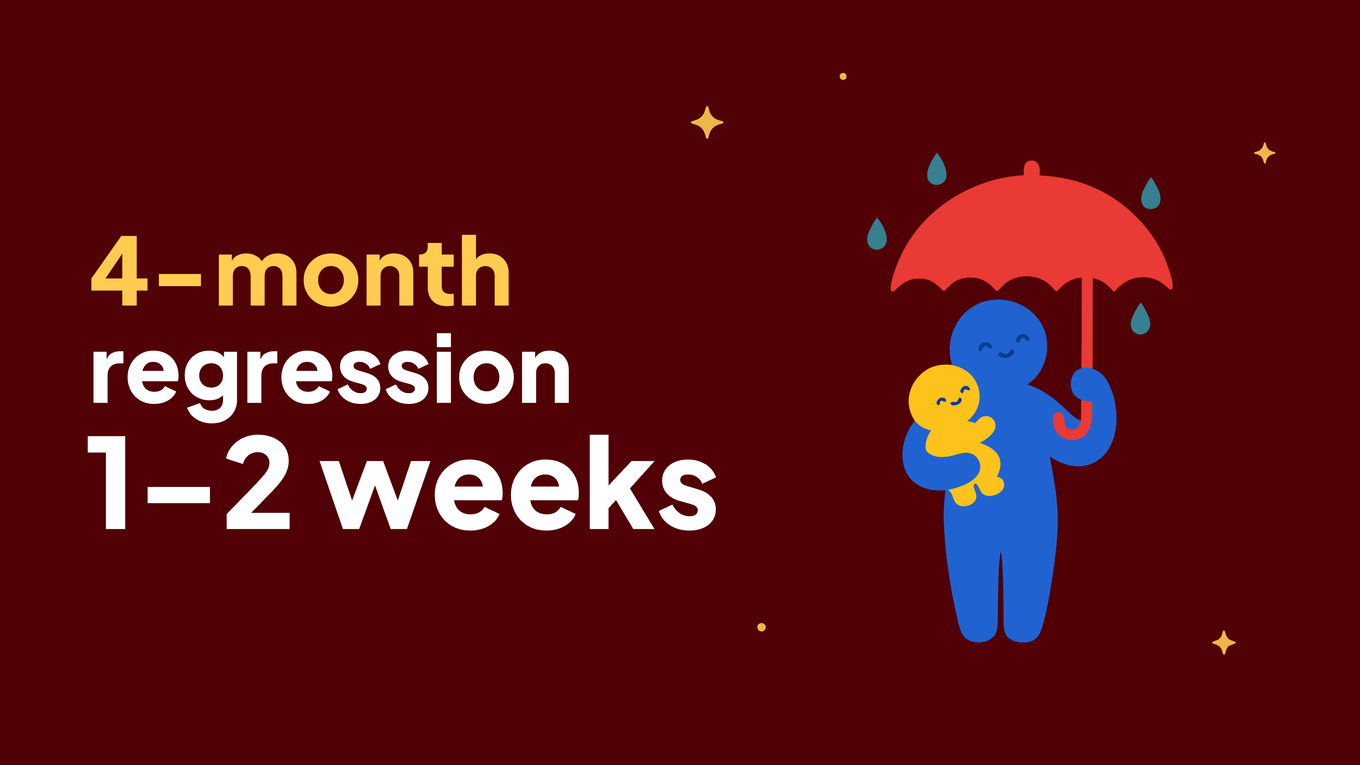
How long a regression usually lasts 1–2 weeks If sleep is still rough after about a month, look for another cause.
Usually 1 to 2 weeks. The end can come as a day or two of unusually long sleep, or as a gradual improvement over several nights.
If sleep is still rough after about a month, the regression itself has probably passed and something else is holding the pattern in place. Often it’s the extra help that got everyone through the hard nights: rocking, feeding or holding to sleep, now expected at every waking. That’s not a mistake. It’s a sign the temporary fix has become the new routine, and you can decide whether to keep it or change it gently.
Does every baby have sleep regressions?
No. One estimate puts it at about half of babies at any of the common ages, and estimates of how many disrupted periods a baby has in the first two years vary widely. Plenty of babies pass through the 6, 12 or 18 month windows with no change you would notice.
Are sleep regressions real?
Where the advice differs. One view treats regressions as predictable bumps that come with development, common enough to plan for. Another holds that there are no fixed, age-based regressions: when sleep gets worse there is a specific cause, such as a new skill, an ear infection, a trip, or a schedule with too little day sleep or a bedtime that has drifted late. tiho treats the windows as times to watch, not events to expect, and reads your baby’s own log for the cause.
The research sits between the two. Studies following babies as they learned to crawl found that night waking rose around the time crawling began, within an overall trend of improving sleep, which supports a link between new motor skills and broken sleep. A large study of infant sleep in two birth cohorts found sleep highly variable through the first two years, with night sleep consolidating mostly in the second year. In other words, bumpy sleep is normal. Whether it arrives on a schedule is the part sources disagree on.
Is it a regression, or something else?
When sleep suddenly gets worse, it helps to check the other usual causes first:
- Illness or teething. Fever, a runny nose, pulling at the ears or poor feeding point here, not to a regression.
- A new skill. Rolling, crawling, pulling up, walking.
- A change at home. A trip, a move, a new caregiver, starting daycare.
- A routine that has slipped. Later bedtimes, a skipped nap, a different wind-down.
- A change in what your baby needs. Most often a nap transition: a baby ready to drop a nap fights naps and wakes early, which looks a lot like a regression. Sleep regression or dropping a nap covers how to tell them apart.
- Your expectations. Night waking at 8 months is still common, and normal sleep at any age includes brief wakings between cycles.
What helps during a regression
- Keep the routine and the timing steady. A consistent bedtime routine is linked to better sleep, and the more consistent, the stronger the link. Hold wake windows that fit your baby’s age (the wake windows cheat sheet has the ranges).
- Give the extra comfort your baby needs. More help for a week or two is fine. Use the same response each time, so the night stays predictable.
- Let new skills happen in the day. Plenty of floor time to practice crawling, standing and walking can make the crib less of a practice space at night.
- Judge by the trend, not the worst night. A regression is the hardest time to judge any method, because everything looks worse than it is.
How this looks depends on your approach. Behavioral: keep the schedule and the settling routine as they were, and add comfort without adding new sleep habits you would later need to undo. Responsive: respond as you normally would, staying consistent so your baby’s wakings meet the same calm answer each time. Both work; consistency matters more than the choice. More in behavioral or responsive.
In tiho, the Insights tab charts the last 7 days, so a rough patch shows up as a dip you can watch end, rather than a feeling that it’s been going on forever.
When to talk to your pediatrician
A regression doesn’t need a doctor. Check in with your pediatrician if your baby has a fever, is feeding poorly, pulls at their ears, snores loudly or seems to pause in breathing during sleep, is unusually sleepy, or if sleep has been very disrupted for more than a few weeks with no clear cause.
Related reading
- The 4-month sleep regression: what actually changes
- The 6 month sleep regression
- The 8 month sleep regression
- The 12 month sleep regression
- The 18 month sleep regression
- The 2 year sleep regression
- Sleep regression or dropping a nap? How to tell
- Dropping a nap: the 3-to-2 and 2-to-1 transitions
- Wake windows by age: the cheat sheet
Frequently asked
What are the sleep regression ages?
The most commonly named are 4 months, 6 months and 8 to 10 months, with occasional bumps at 12 months, 18 months and 2 years. In weeks, that is roughly 15 to 20, 25 to 28, 35 to 43, 51 to 55, 77 to 83 and 103 to 109.
How long does a sleep regression last?
Usually 1 to 2 weeks. It can end with a day or two of unusually long sleep or improve gradually. If sleep is still rough after about a month, something else is likely going on: a nap transition, illness, or a temporary habit that has stuck.
Does every baby go through sleep regressions?
No. One estimate puts it at about half of babies at any of the common ages. Many babies pass through some of these windows with no visible change at all.
Is there a 3 month sleep regression?
What parents call the 3 month regression is usually the 4 month one arriving early. The change in sleep cycles behind it can start around 3 to 4 months, about 15 weeks at the earliest.
Are sleep regressions real?
Sources disagree. One view treats them as predictable bumps tied to development. Another holds that there are no fixed regressions, and that sleep which gets worse has a specific cause, such as a new skill, illness, a trip or a schedule that no longer fits. Research on crawling supports a link between new motor skills and more night waking.
Should I change sleep methods during a regression?
Usually not. A rough week is the hardest time to judge any method, because everything looks worse than it is. Keep your routine, watch the trend over two weeks, and decide then.
Is it a regression or teething?
It can be hard to tell, and the two can overlap. Signs of illness such as fever, poor feeding or pulling at the ears point away from a regression and toward a call to your pediatrician.
Sources
- Sleep as a mirror of developmental transitions in infancy: the case of crawling · Monographs of the Society for Research in Child Development
- Locomotion and nightwaking · Child: Care, Health and Development
- Normal sleep development in infants: findings from two large birth cohorts · Sleep Medicine
- Bedtime routines for young children: a dose-dependent association with sleep outcomes · Sleep
More in Research

Are baby sleep apps worth it? An honest look
What sleep tracking genuinely tells you, what the apps oversell, the category's real failure modes, and a checklist for judging whether any of them earns its price.
The 4-month sleep regression: what actually changes
Around four months, babies trade newborn sleep for adult-style cycles, and nights get louder before they get better. What the research says, and what helps.